

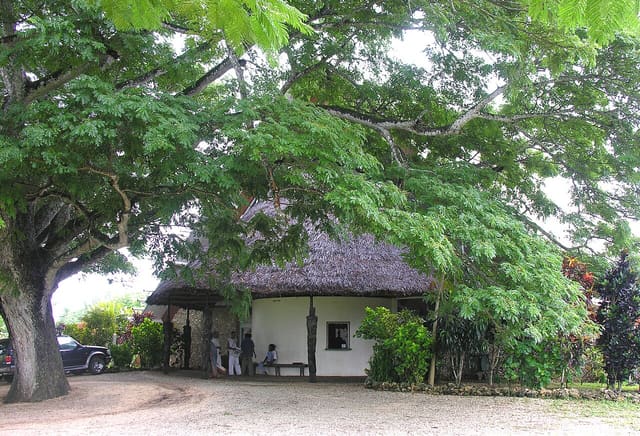
Vanuatu Cultural Centre & National Museum
Vanuatu's national cultural institution, home to the National Museum, opposite Parliament in Port Vila. A good first stop to understand kastom, sand drawing and the islands' many cultures.
This content is a draft that has not been reviewed yet.
Stamp
Not collected yet.
Collect it when you get there, or scan the QR code on site.
Open stamp bookListen
Photos
-
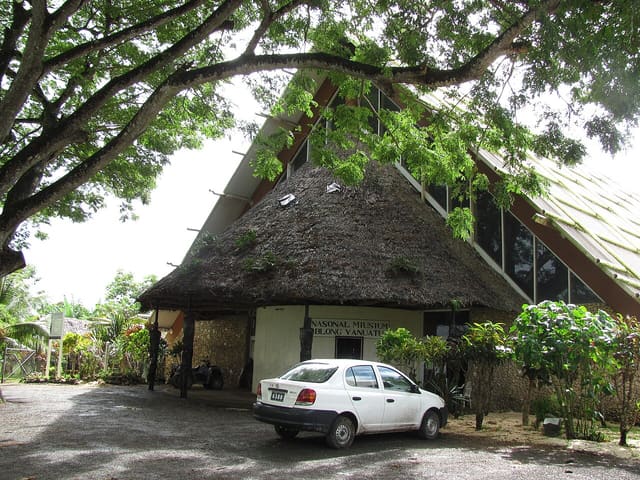
The National Museum building in Port Vila
Guide text
Short guide (~1 min)
Welcome to the Vanuatu Cultural Centre, known in Bislama as the Vanuatu Kaljoral Senta, or VKS. It is the country's national cultural institution, and it stands in Port Vila opposite the National Parliament. Inside is the National Museum of Vanuatu. Its collections include masks, slit gongs, model canoes and pottery, including ancient Lapita pottery made by some of the first people to settle these islands. The centre also looks after national archives, film and sound recordings, and the work of community fieldworkers who record oral traditions across the islands. Look out for sand drawing, a way of telling stories and passing on knowledge that UNESCO lists as intangible cultural heritage. Some objects and recordings are tabu under kastom and are not shown to everyone, so respect any restrictions. Allow at least an hour here before heading out to the villages and islands.
Full guide (~3 min)
Welcome to the Vanuatu Cultural Centre, the Vanuatu Kaljoral Senta in Bislama and the Centre Culturel du Vanuatu in French. Its staff often simply call it VKS. It is the national body responsible for recording, protecting and promoting the many cultures of Vanuatu, and it stands in the Nambatu area of Port Vila, opposite the National Parliament.
The centre is an umbrella for several national institutions. The best known to visitors is the National Museum of Vanuatu, but the same organisation also runs the National Library and National Archives, a film, sound and photo unit, a programme that surveys cultural and historical sites, and a network of community fieldworkers. Since the 1970s these fieldworkers, men and later also women, have recorded oral traditions, songs and knowledge in their own islands, building one of the most important cultural archives in the Pacific.
The museum building was designed with inspiration from the architecture of Vanuatu's northern islands. Its exhibition hall holds masks, slit gongs, model canoes and pottery. Archaeological material includes Lapita pottery, linked to some of the first people who reached these islands around three thousand years ago, and finds from excavations such as Chief Roi Mata's burial site on Eretoka island. There are also natural history collections, including bones of extinct horned turtles found at the Teouma archaeological site on Efate.
One highlight is sand drawing, called sandroing in Bislama. With one finger, an artist traces a continuous line in sand or ash to tell a story, record knowledge or send a message. Sand drawing from Vanuatu is inscribed on UNESCO's list of intangible cultural heritage, and the centre is one of the easiest places to see it.
The museum works in its own way. Some objects and recordings are tabu under kastom: certain material may only be seen by men, by women, or by members of a particular community. Kastom objects can be deposited by their owners for safekeeping, with access managed according to kastom rules. Please respect any area or item that is not open to you.
In the entrance hall, the museum shop sells carvings, woven baskets, books and recordings made across the archipelago; sales help develop the collection. Plan at least an hour, or nearer two if you like to read labels and talk with staff. It is an ideal rainy-day visit and a useful introduction before you visit villages or Chief Roi Mata's Domain.
Practical info
- Opening hours
- Being verified
- Admission
- Being verified
- Suggested time
- 90 min
Etiquette
- Respect any object, room or recording marked as tabu or not open to visitors.
- Ask staff before taking photos inside the museum.
Sources
- Vanuatu Tourism Office — Vanuatu Cultural Center & National Museum
- Vanuatu Kaljoral Senta — official website
- Wikipedia — National Museum of Vanuatu
- Wikipedia — Vanuatu Cultural Centre
- Vanuatu Tourism Office blog — Three cultural experiences to try in Efate
- OpenStreetMap — Musée National de Vanuatu (node 1208562570)
- Photo: Phillip Capper (PhillipC) · CC BY 2.0
- Photo: Torbenbrinker · CC BY-SA 3.0